
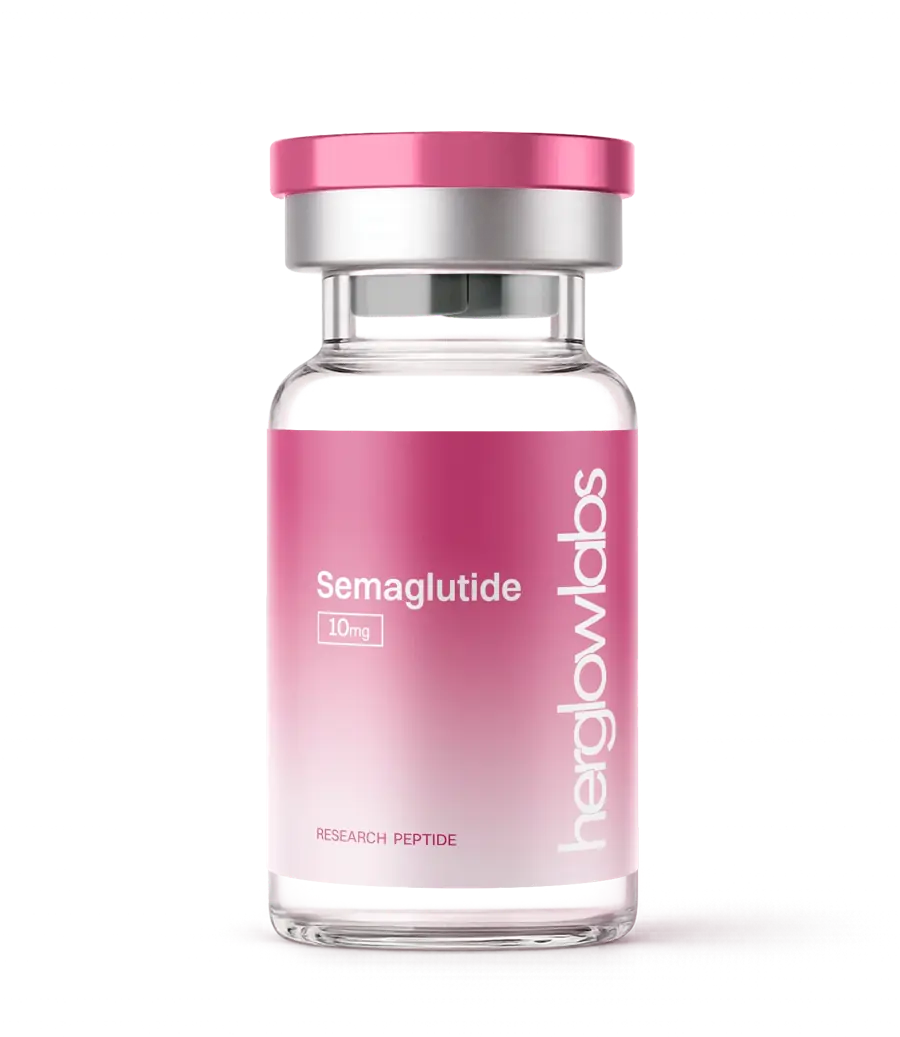


Semaglutide
$119.00 – $149.00Price range: $119.00 through $149.00Earn up to 75 points.
Semaglutide 10mg is a synthetic GLP-1 receptor agonist supplied by HerGlowLabs as a lyophilised research peptide, with batch-specific Certificates of Analysis. For in-vitro laboratory research only; not for human or animal use.
Semaglutide is a synthetic GLP-1 receptor agonist studied for its interactions with metabolic and endocrine signalling pathways. As a modified analogue of glucagon-like peptide-1 (GLP-1), it allows researchers to investigate how incretin receptors influence cellular communication, glucose-dependent signalling and energy regulation.
Its molecular structure has been engineered to resist rapid enzymatic degradation and extend biological activity, making Semaglutide an established reference compound in GLP-1 receptor research.
HerGlowLabs supplies Semaglutide as a lyophilised research peptide for laboratory investigation. This product is not intended for human or animal use.
Semaglutide at a glance
- Research compound: Semaglutide
- Peptide classification: GLP-1 receptor agonist
- Primary research focus: Incretin signalling, metabolic pathways and endocrine regulation
- Receptor target: Glucagon-like peptide-1 receptor (GLP-1R)
- Molecular composition: Modified 31-amino-acid peptide
- Physical form: Lyophilised powder
- Vial size: 10mg
- Quality documentation: Batch-specific Certificates of Analysis where available
- Dispatch: Melbourne, Australia, via Australia Post Express
Understanding GLP-1 and its role in metabolic research
Glucagon-like peptide-1 is an incretin hormone produced primarily by specialised intestinal cells in response to nutrient intake.
GLP-1 participates in communication between the gastrointestinal system, pancreas and central nervous system. Its receptors are involved in biological processes associated with glucose regulation, endocrine activity and energy balance.
Because naturally occurring GLP-1 is rapidly degraded, researchers often use modified GLP-1 analogues to investigate receptor activity over extended experimental periods.
Semaglutide is one such analogue.
By activating the GLP-1 receptor, Semaglutide provides a model for examining how incretin-mediated signalling contributes to broader metabolic regulation.
Why Semaglutide is studied in endocrine and metabolic science
Metabolic regulation involves communication between several organs, hormones and cellular signalling networks.
Rather than operating through a single biological pathway, GLP-1 receptor activation can influence multiple physiological processes.
Semaglutide is therefore relevant to research involving:
1. Glucose-dependent endocrine signalling
GLP-1 receptor activation is associated with insulin secretion under elevated glucose conditions. Researchers investigate the cellular mechanisms responsible for these glucose-dependent responses.
2. Pancreatic hormone regulation
GLP-1 signalling is involved in the regulation of pancreatic hormone activity, including insulin and glucagon. These processes are important in understanding endocrine communication.
3. Gut–brain communication
GLP-1 receptors are present in regions involved in gastrointestinal and central nervous system signalling. Research explores how these networks communicate and contribute to energy homeostasis.
4. Metabolic adaptation
Scientists investigate how GLP-1 receptor pathways interact with broader systems involved in nutrient processing, cellular energy regulation and metabolic responses.
5. Receptor pharmacology
Semaglutide provides a useful compound for investigating receptor activation, signalling duration and molecular interactions within the GLP-1 receptor family.
These are scientific research areas and do not constitute claims about the effects of HerGlowLabs research material in humans.
What makes Semaglutide different from natural GLP-1?
Naturally occurring GLP-1 has a short biological half-life because it is rapidly degraded by enzymes, particularly dipeptidyl peptidase-4 (DPP-4).
Semaglutide contains structural modifications that change its pharmacological properties.
These include an amino-acid substitution that improves resistance to DPP-4 degradation and a fatty-acid-containing side chain that promotes albumin binding.
Together, these modifications contribute to prolonged activity compared with native GLP-1.
For researchers, these characteristics are relevant when studying peptide stability, receptor engagement and the relationship between molecular structure and biological activity.
Exploring GLP-1 signalling in women’s metabolic health research
Metabolic and endocrine regulation are important areas of women’s health research.
Scientists investigate how incretin pathways interact with hormonal changes, insulin sensitivity and metabolic regulation across different physiological conditions.
For example, research into conditions such as polycystic ovary syndrome (PCOS) includes investigation of insulin resistance and metabolic dysfunction. GLP-1 receptor agonists have also been studied clinically in this context.
However, these findings relate to specific pharmaceutical preparations and clinical research. They do not establish the suitability, safety or effectiveness of research-grade Semaglutide for treating PCOS or any other condition.
Semaglutide’s relevance to women’s metabolic research lies in its established GLP-1 receptor activity and the broader scientific interest in incretin-mediated metabolic pathways.
Comparing Semaglutide with other incretin research compounds
Semaglutide belongs to a growing category of compounds investigated for their interactions with metabolic receptors.
| Compound | Receptor activity | Research distinction |
|---|---|---|
| Semaglutide | GLP-1 | Selective GLP-1 receptor agonism |
| Tirzepatide | GIP and GLP-1 | Dual incretin receptor agonism |
| Retatrutide | GIP, GLP-1 and glucagon | Triple receptor agonism |
These differences allow researchers to investigate how activating one or several receptor systems influences signalling responses.
Semaglutide is particularly useful as a reference compound in comparative GLP-1 receptor research because its primary receptor target is well characterised.
Third-party testing and product quality
HerGlowLabs recognises the importance of analytical documentation when sourcing compounds for laboratory research.
Third-party testing can provide information about peptide identity, purity and sample composition.
Common analytical techniques include:
- High-performance liquid chromatography (HPLC): Used to assess chromatographic purity.
- Mass spectrometry (MS): Used to investigate molecular mass and support compound identification.
- Batch-specific analysis: Provides results associated with the sample submitted for testing.
Where available, Certificates of Analysis (CoAs) can be accessed through the HerGlowLabs website.
Researchers should review the documentation relevant to their specific batch. Chromatographic purity alone does not establish sterility, endotoxin status or suitability for administration.
Semaglutide product information and Australian dispatch
HerGlowLabs supplies Semaglutide in sealed research vials containing lyophilised peptide powder.
Orders are dispatched from Melbourne, Victoria, using Australia Post Express.
Typical shipping estimates are approximately 2–4 business days for most Australian destinations and 4–6 business days for Western Australia, depending on postal operations.
Tracking information is provided following dispatch.
Available vial strengths, pack configurations and pricing are displayed in the product selection options.
Laboratory storage considerations
Appropriate storage practices are important for maintaining the integrity of peptide research samples.
Lyophilised Semaglutide should be stored according to the supplier’s validated storage specifications.
General laboratory considerations include:
- Protecting sealed vials from moisture and unnecessary light exposure.
- Avoiding excessive heat during storage.
- Minimising repeated temperature fluctuations.
- Using appropriate laboratory procedures to prevent sample contamination.
- Following validated stability protocols for prepared solutions.
Stability can depend on formulation, temperature, solvent, concentration and storage duration. Conditions should not be assumed to be interchangeable between different preparations.
Semaglutide technical specifications
| Specification | Information |
|---|---|
| Compound name | Semaglutide |
| Alternative identifier | NN9535 |
| CAS number | 910463-68-2 |
| Molecular formula | C187H291N45O59 |
| Molecular weight | Approximately 4113.58 g/mol |
| Peptide length | 31 amino acids |
| Compound family | GLP-1 receptor agonist |
| Receptor target | GLP-1R |
| Physical appearance | White to off-white lyophilised powder |
| Vial size | 10mg |
| Analytical purity | Refer to the applicable batch CoA |
| Research classification | Laboratory research material |
| Intended use | In-vitro laboratory research only |
Frequently asked questions about Semaglutide
Why is Semaglutide used in metabolic research?
Semaglutide activates the GLP-1 receptor, which participates in glucose-dependent endocrine signalling and metabolic regulation. Researchers use the compound to investigate receptor pharmacology, cellular responses and incretin-related pathways.
What is the relationship between Semaglutide and GLP-1?
Semaglutide is a modified analogue of the naturally occurring hormone GLP-1. Its structural modifications improve resistance to degradation and extend biological activity compared with native GLP-1.
Does Semaglutide activate multiple incretin receptors?
Semaglutide primarily acts as a GLP-1 receptor agonist. It does not share the dual GIP/GLP-1 receptor profile of Tirzepatide or the triple receptor profile of Retatrutide.
Why is Semaglutide relevant to women’s metabolic research?
GLP-1 pathways are relevant to metabolic and endocrine regulation, including research areas involving insulin sensitivity and conditions such as PCOS. However, evidence from clinical studies of approved medicines should not be interpreted as evidence supporting human use of research-grade Semaglutide.
What is the purpose of lyophilisation?
Lyophilisation is a freeze-drying process that removes water from a formulation under controlled conditions. It is commonly used in peptide manufacturing to support storage and handling stability, although actual stability depends on the formulation and storage conditions.
Can I access a Certificate of Analysis?
HerGlowLabs publishes available third-party testing documentation through its website. Researchers should consult the applicable batch-specific CoA to review analytical results.
Is research-grade Semaglutide the same as prescription Semaglutide?
No. Semaglutide is the active ingredient in certain approved prescription medicines, but HerGlowLabs research material is not an approved pharmaceutical product. It should not be considered interchangeable with a regulated medicine.
What does the stated vial strength represent?
The stated milligram quantity indicates the nominal amount of Semaglutide supplied in the vial. It is a product specification, not a recommended dose or administration instruction.
Does HerGlowLabs provide Semaglutide for personal use?
No. HerGlowLabs Semaglutide is supplied strictly for legitimate laboratory research. It is not intended for personal use, self-administration, human consumption or animal administration.
Research use disclaimer: HerGlowLabs Semaglutide is supplied exclusively for legitimate in-vitro laboratory research. It is not an approved medicine, supplement or cosmetic product and is not intended for human or animal use. Purchasers are responsible for ensuring their activities comply with applicable Australian laws, research requirements and laboratory safety standards.
At Herglowlabs, we aim to deliver your order quickly, safely, and reliably. All orders are shipped from our Sydney/Melbourne locations via Australia Post Express for fast, tracked delivery.
Shipping Rates
- Free Express Shipping – Orders over $200 AUD
- Flat Rate Express Shipping – $14.95 AUD for orders under $200
Delivery Times
- Metro Areas: 2–4 business days
- Regional Areas: 3–5 business days
Delivery timeframes are estimates provided by Australia Post and may vary depending on your location and seasonal demand.
Dispatch Times
- Orders placed before 12:00 PM AEST are shipped the same business day
- Orders placed after 12:00 PM or on weekends/public holidays will be dispatched the next business day
Tracking Your Order
Once your order has been shipped, you will receive an email with your Australia Post tracking number. You can track your order via the Australia Post website.
International Shipping
We currently ship within Australia and New Zealand only.
Order Issues & Delays
If your order is delayed, lost, or arrives damaged, please contact us within 48 hours of delivery so we can investigate and arrange a replacement if eligible under our Quality Assurance Guarantee.
Intended Use:
This product is intended strictly for qualified laboratory researchers. It is not for human or veterinary consumption and must not be used as a drug, food additive, cosmetic, or household item.
Disclaimer:
This compound is sold for in vitro research and educational purposes only. It has not been evaluated by the FDA and is not intended to diagnose, treat, cure, or prevent any disease. All buyers must be authorized research personnel or institutions.
Terms of Sale:
By purchasing this product, you confirm that you are a qualified professional conducting lawful scientific research. Herglowlabs and its affiliates are not liable for any misuse or mishandling of this material.


Reviews
Clear filtersThere are no reviews yet.